

Why Generic Business Software like Zoho and Odoo Keep Failing Nigerian SMEs
Generic business software is the first thought that crosses the mind of many business owners dealing with operations management issues. Most of the time, business owners have already tried to solve their operations problem. They have heard the advice; stop using WhatsApp to run your business, invest in proper software; and they have acted on it. They have paid for subscriptions, sat through demos, assigned a staff member to manage implementation, and waited for things to improve.
Months later, the generic business software sits largely unused. The team has gone back to WhatsApp. The business owner is frustrated, poorer, and now more skeptical than ever that technology can actually help.
This is not a failure of ambition. It is a failure of fit and understanding exactly why it happens is the first step to solving it properly.
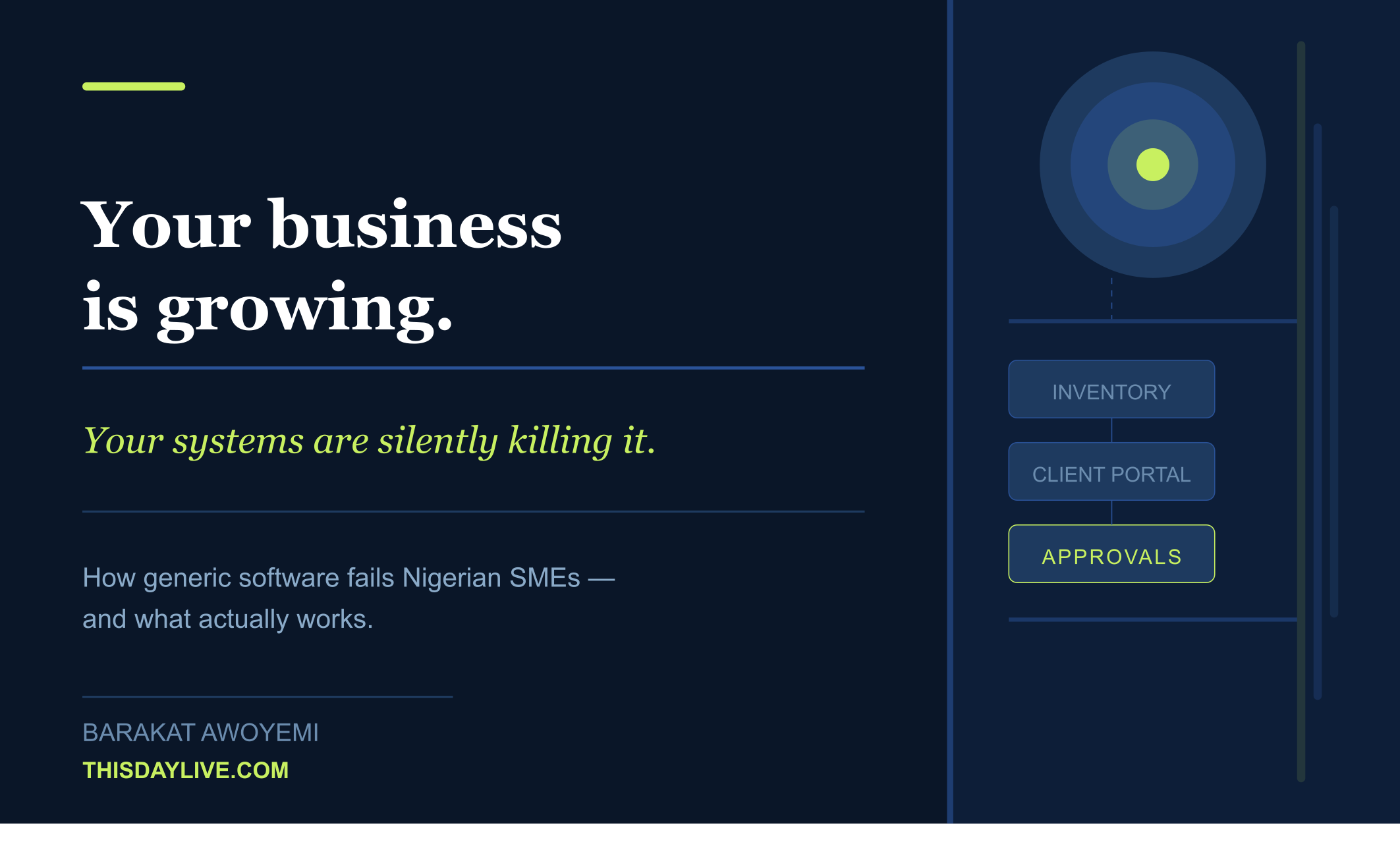
This post expands on a theme I explored in my recent article for ThisDay Newspapers: “Your Business Is Growing, Your Systems Are Silently Killing It”
The Generic Business Software Architecture Problem Nobody Explains to You
Generic Business Software platforms like Zoho, Odoo, SAP Business One, and similar ERP or CRM tools are genuinely powerful. They are not bad generic business software. But they are built on a foundational assumption that rarely matches the reality of a Nigerian SME: that your business operates according to a standardised, predictable workflow.
These platforms are designed around what is called opinionated architecture meaning they have a built-in, fixed opinion about how a business should process orders, manage inventory, track clients, and generate reports. That opinion was formed in European and American markets, by developers studying European and American businesses.
When your Lagos-based or Nairobi-based distribution company tries to implement Odoo, you are not simply buying generic business software. You are being asked to restructure your operations to conform to the logic of a system that has never encountered your supplier relationships, your payment terms, your part-payment culture, your multi-location informal warehouse arrangements, or your staff’s existing digital habits.
The software does not adapt to you. You are expected to adapt to it.
Why Staff Abandon It Within Weeks
There is a well-documented pattern in enterprise software adoption called user resistance, and it is particularly acute when the software does not match how people actually work.
Your stockkeeper has a mental model of inventory management built over years. Your sales team has a rhythm for logging client interactions. Your operations manager has a system, imperfect as it may be, for compiling weekly reports. When new software arrives and demands that all of these people change their behaviour simultaneously, while also learning a complex new interface, while also continuing to meet their daily targets, the path of least resistance wins every time.
WhatsApp wins. The spreadsheet wins. The familiar wins.
This is not laziness. It is entirely rational human behaviour. And the solution is not to discipline staff into compliance. It is to build systems that align with how your team already thinks and works, rather than demanding they rewire themselves for software built for a different market.
The Customisation Trap
Some business owners discover that generic business software platforms like Zoho and Odoo offer customisation options, and they invest heavily in trying to bend the software to their needs. This approach has a real cost that is rarely disclosed upfront.
Customising an off-the-shelf platform means working within its existing data structure, its module logic, and its update cycle. Every customisation you build sits on top of someone else’s architecture. When the platform releases a major update (which enterprise software does regularly), your customisations can break. You then pay a developer to fix them. The cycle repeats.
You also inherit the platform’s complexity. Zoho and Odoo are feature-rich because they are built for thousands of different business types. Your trading company does not need 80% of what the platform offers, but your staff will encounter that 80% every time they log in. Complexity that is irrelevant to your workflow is not neutral. Actually, it is friction that slows adoption and increases errors.
What Custom-Built Internal Tools Actually Solve
A custom internal tool built specifically for your business starts from a completely different premise. Instead of asking “how do we fit this business into the software?”, the question becomes “how does this business actually operate, and how do we build something that serves that reality?”
This means:
Your terminology, not theirs. If your team calls it a “loading order” rather than a “purchase order,” the system uses “loading order.” This sounds minor. It is not. Terminology mismatch is one of the leading causes of data entry errors and staff confusion in generic software implementations.
Your workflow, not a generalised one. If your approval process involves a floor manager, a logistics coordinator, and a final sign-off from the director (in that specific sequence), the system enforces that sequence. It does not offer you a generic approval module that you have to configure, test, and hope works correctly.
Only what you need. A custom system built for a wholesale distribution company contains the features that company needs: inventory tracking, client order management, delivery logging, and financial reconciliation. It does not contain a project management module, a social media integration, or a customer portal built for a retail context. The interface is clean. The learning curve is short. Adoption happens because the tool makes people’s jobs easier rather than harder.
Your data structure. Your business generates data in specific patterns. A custom system is built to capture, organise, and report on that data in the way that is actually useful to you — not in the way that a platform’s default reporting module happens to present it.
The Real Cost Comparison
Business owners often hesitate at the upfront cost of custom development and choose a monthly subscription to a generic platform instead. This is understandable. It feels lower risk.
But consider the full cost of a failed generic software implementation: the subscription fees paid during a six-month trial period, the staff hours spent on training that ultimately leads nowhere, the developer fees for customisation attempts, the productivity lost during the transition, and most significantly, the operations problems that remain unsolved because the tool was abandoned.
When you add those costs together, the economics of custom development frequently look more favourable than they did at first glance. And unlike a failed generic implementation, a well-built custom system is an asset that continues to serve your business as it grows, rather than a subscription that resets to zero value the moment you stop paying.
The Right Question to Ask
If you have tried generic software and found it wanting, the question is not whether to try a different generic platform. The question is whether your business has reached the point where it deserves tools built specifically for how it operates.
Most Nigerian SMEs turning over ₦50 million or more annually have reached that point. The cost of continuing with mismatched tools in lost orders, staff inefficiency, reporting delays, and owner dependency consistently exceeds the cost of solving the problem properly.
The businesses that scale cleanly are not the ones that found the right off-the-shelf software. They are the ones that stopped trying to fit their operations into someone else’s system and built something that fit them instead.
Barakat Awoyemi is the founder of Barola Technologies Limited, a business systems development company that builds custom internal tools for Nigerian SMEs. If your business has outgrown its current systems, you can reach her at info@barolatech.com.